Showing posts sorted by date for query camouflage. Sort by relevance Show all posts

17 July, 2026

OTHER CONCEPTS | SPACE WARFARE | PART 5 - HARD SCI-FI x STARFLEET

PITCHING A GREEK TRIREME AGAINST A WW2 WARSHIP

THIS POST CONTAINS QUITE TECHNICAL DETAILS AND SPECULATIVE COURSE OF ACTION

MEET THE COMBATANTS


Galaxy-class USS EANES, NCC-1434
(After Gil Eanes, portuguese sailor from the 1430s which ended the myth of sea monsters in the northwestern African coast)

In the Star Trek universe, Galaxy-class starships were put in service around the 2360s into the 2370s by the Starfleet, crewed by between 1000 to 6000 people; these 641 meter behemoths were usually designated as explorer ships. Like most Starfleet vessels, it is composed of a large saucer, a neck, and two warp nacelles.
The average speed for cruising can be around warp 6, though at times warp 9 is possible but risky for long periods.

Armaments include a total of 26 phaser arrays (halves above and below the saucer), 2 torpedo launchers (250 photon torpedoes), and antimatter mines, and of course the staple deflector shields.
There isn't much information about how powerful phasers can be, citations say it takes several seconds to melt through granite, for further strength calculations 1 second will be considered for 1kg, for a total power estimate of 1.7 MJ/s, or roughly 2MW. In the TNG series throughout episodes we can estimate that typical firing power for ship-to-ship combat is between 40 and 400 MW, the latter of which is more than enough to overpower the ship’s shielding.
The TNG manual says phasers travel just under lightspeed with an effective range of 300 thousand kilometers.

Photon torpedoes get their power from matter/antimatter annihilation, which releases great quantities of radiation. Photon torpedoes are warp-capable depending on model, traveling up to 0.17-0.2c, they have an approximate range of some 300 thousand kilometers, but this can be extended at the expense of torpedo yield to 3.5 million km. 

The series speaks of setting levels for torpedo yield, which commonly go from 1 to 16, called isotons, and at one time is said that a level 25 warhead could level a city, so I'd imagine they'd have the yield of tactical nukes overall, is implied that these levels are not linear, since a 54 isoton could blow up a planet. The Star Trek Next Generation Technical Manual page 129 says that about 1.1-1.5 kg of anti-matter are carried by your typical photon torpedo, and conversion parameters set the explosive yield at a maximum of 64,4 megatons, it could be less if the annihilation is not total.

So basically this ship's capabilities are taking out a ~4 km wide asteroid with a single torpedo (from the gravitational binding energy equation), and particle beans able to vaporize through up to 200kg of rock a second.

On the other side of the ring, we have a fleet designed by me:

All ships follow the same construction rules as the blog's flagship the Scitalis, including the camouflage pattern

SCITALIS-class Support Cruisers
(The Scitalis is a medieval beast that is said to possess beautiful shiny marks)

Each vessel is about 320 meters long, I calculated, given an overestimate of the density of submarines, for 400-600 kg/m³ to account for the plates, reactor and skirts, that each ship would have a dry mass around 50 or 60 thousand tons, or the weight of two moderately-sized battleships, it could be way less if it can be manned by a small crew, or none at all, which is why I'm counting on a computer to crew the ship.
 
In the last post I calculated that a decent spin for the ship would impart over 60 G of acceleration on the ends of the ship, and knowing that the tensile strength of steel is between 400-800 MPa, and that the ship has an overall cross-section of the deck of some 24-35m, the stress shouldn't be above 20 MPa per square meter, and so the ship wouldn't rip itself apart unless it is spinning anything over 160 rpm (as fast as the blades of a fan).

No warp drives or superluminal travel capabilities, minimum artificial gravity, top speed just about solar escape velocity at 50 km/s, no in-atmosphere flight capabilities. No energy shielding, relying on inclined and thickened steel plating for projectile protection, which can be as thick as 1 meter in the most critical parts, with effective thickness of 2-3 meters due sloped armor.

For weapons, each broadside is equipped with 75x 80mm 7,4 ton fast paced artillery guns (40 rounds/minute). And 6x 7,0 ton kinetic kill dispersers (basically a shotgun with 300kg of pellets a shot), firing in a 30° cone.
Making this ship 2% cannons by mass, muzzle velocity at ~850m/s for 10 kg artillery and 100g pellets.

The typical barrel life for WW2 warships was between 200 to some 300 shots depending on what cannon, while allowance (typical/minimum ammo carried) was up to half as much, with less than 50-60 shots fired per battle. By the same standards, since we have 150 cannons across the ship, our allowance is about 100 rounds per cannon, and our typical munitions cache is under 15 thousand rounds (150 tons of shells), had one vessel have to empty their stockpile, it would take approximately six minutes using a single broadside, costing us that whole set of weapons.

If the cannons on one side concentrate fire inside a 10 meter wide area, each salvo would impart over 270 megajoules of energy, or >1.73 MJ per m². 

Jaculus-class Gunships
(The Jaculus is a medieval beast, a flying serpent that hides on top of trees and strikes from above)

While the Scitalis-class hulls are pretty scary for their suppressive fire capability, a Jaculus-class ship, as the name suggests is intended to attack directly with a powerful strike. Because Jaculus ships are a big collective of heavy weapons, they must be scouted by lighter and faster ships which give them space and time to aim their salvos.

The frontal hull of the Jaculus possess parabolic geometry to deflect incoming shells, the main array of 7x 120mm cannons is endearingly called "Trumpets" as a reference to the trumpets in the book of Apocalypse, each shell weighing 20 kilograms, fired at 1,7km/s and 10 rounds a minute. With 1000 shells aboard, the ammunition types are broken in ¾ shaped explosives, and ¼ shredder rounds which break apart to maximize structural damage. The main arsenal in a Jaculus gunship are 24x 100kt plutonium fission warheads, these are usually kept unarmed and separated at different parts of the ship, in extreme situations the three-man crew will initiate the assembly which takes a few minutes, and then deploy the weapon.


The Jaculus cannot maneuver its individual Trumpet cannons, since they are mounted on the ship's structure. The whole vessel has to be pointing directly at the target as the small face size of the ship grants all cannons greater accuracy regardless of distance, for this reason it possesses greater turning capability than its companions.

A full Trumpet salvo can deliver >202 MJ of energy at once, making it as powerful as a Scitalis-class ship. Each side of the ship is lined with 15x 80mm cannons like the ones used in Scitalis-class ships, their purpose is purely defensive at first.

Archer-class Ranged Battleship
(I didn't find a beast cool enough to name it for its ability)

The Archer-class ships have very similar hulls to the Jaculus-class, but the Archers exchange caliber for range and speed, in place of 120mm cannons they sport 90mm with superior muzzle velocity, at 3 km/s, 20 rounds a minute, and 15kg shells. Most of their arsenal are shredder and cluster rounds. The ordinance that gives the ship hull its name are curved trajectory missiles and flashbang/flare charges, which are designed to fly along a predetermined curved path in the hopes of striking the target from an inconvenient angle, at adjustable speeds up to 5 km/s.


If Scitalis-class ships are in the middle of the battle, and Jaculus aim for the citadels, Archers rely mainly on taking down moderate value targets, like enemy ordinance, fighters, and peripherals as well as providing field intel and combat interference from a distance.

THE FIRST ENCOUNTER
2372.74, Omicron sector
Unknown presence detected moving across the UFP-Romulan neutral zone. The Federation fears another Borg threat. As of a few years ago, Starfleet has sent Galaxy-class USS EANES to verify the strange movements last seen near the Iconia system…


From the crew’s point of view the readings of the potential hostiles are not threatening, the detection of no shields and minimum vital signatures inside the group would raise curiosity but proceeding with caution is the order. The bridge would transmit their salutations and warnings in the name of the United Federation of Planets, but they answer with a negative, claiming the Iconia system and the ancient technology within it under their control.

The first encounter fleet is composed of two archers and two scitalis ships, captain Leonhardt from the USS Eanes orders the shields to be activated, and that the rebel fleet surrenders to the UFP. To no avail, the two archers strike first with a full cannon salvo against the starfleet ship, just to be stopped by the energy shield, an immediate surprise for the home side.

The Eanes crew is slightly less worried about the aggression capabilities of the enemy, as their attack didn’t even scratch their deflector shields a bit.
 
 
Their science official onboard is rather confused with the primitive armament they are being attacked with, the crew considers transmitting again, as the rising of a new spacefaring civilization sounds of importance to the Federation. Still, they are received with aggression, no known language in either side's catalog makes for a stable communication. As the weapons seem of no effect at all, the squadron starts to maneuver around the planet for a retreat.

I'm not sure about other captains, but I'm pretty sure it wouldn't be fair to fire back at such puny threat at first, as it had occurred several times across the series. Yet the Eanes follows the group around the planet, and as soon as the initial report from the fleet is analyzed in the next dozen minutes, a small object crosses space at some 10 km/s, from beyond the horizon in the direction of the starfleet ship. The collision with the frontal shields reveals that the object was a small 100 kiloton fission bomb, doing a small dip in the shields reading like those created by phasers in typical combat situations. Now this is the signal the crew needed to get ready for combat, despite less advanced, the civilization clearly sees them a threat to be dealt with, and so the crew decides upon showing who's boss, maybe this opens space for negotiation.
 
A 20-kiloton device can irradiate up to 100 R in a radius of 50km, using the inverse square law, we can say the explosion released 250 kR/km² at 1km from its center, this means that any nukes we launch at the Eanes here will be harmless to our computers and crew even at distances as close as less than 20-50km, as they are protected by 1m thick steel plating and possibly water as well (to get the radiation dose down to a billionth of the exposure), however, the radiation released by a photon torpedo would be so high, that the radiation would be lethal from as far as probably 500-1000 kilometers without some even thicker shielding. Although the starfleet ships have windows that would allow the radiation to penetrate, the deflector and cruising shields are good enough to deal with it during warp as usual, so I'm not even counting on giving the crew radiation sickness from a few nukes near the bridge.


THE SECOND ENCOUNTER
A few phaser beams are shot against the nearest battleships, cutting through the 1m thick steel plating and the ship's internals in less than 1 minute, depending on what exactly are phasers made of, it might not be very effective at all because of the shapes and structures of the hulls, but had it operate maximum effectiveness it would easily vaporize through 5 tons of steel in some 30 seconds, the rapid expansion of the material still causes explosions along where the beam hits. A ship hit with this sort of weapon for more than a pair of seconds anywhere will be taken out easily. No amount of nukes across the frontal shields of the Eanes will stop it, the fleet stops and regroups in a point far above the planet.
 
With the mutual silent cease-fire the two sides maneuver in space and observe each other.

The surviving scitalis ship relays the result of nuclear attacks as it retreats past the organizing defense fleet, composed of seven scitalis-class ships, four archers and four jaculus gunships, all of which start dispersing at full speed around space. The longer ships start to spin through space while the manned ships skim behind, keeping themselves locked with the Eanes on sight. The captain orders immediate response to the detected new wave of attacks. The scitalis ships cannons light in sequence like Christmas lights as they fire towards the pilons of the warp nacelles and neck of the Eanes, as they are seemingly the weakest structures of the ship, the rain of shells does not do much being promptly stopped by the shielding, the enemy crew orders the computers to concentrate fire on the closest of the warp nacelles to try and overwhelm the shields, maybe it could lower them on other parts of the Eanes. Seeing the shield lecture dip down little by little prompts the Eanes to start attacking the support cruisers but the phaser banks can't get a good reading nor straight shot through the erratically spinning ships, defensive sprays of buckshots also partially block the phaser beans that do manage to hit the ships for a fraction of a second at a time.

So here where the course of conflict diverges in two scenarios:
  1. The release of single photon torpedo annihilates the whole enemy fleet, as I'm not counting they would be much further than a few hundred km from each other.
  2. The crew agrees to not use PTs for their large destructive power, and because they still intent to establish dialogue. It is possible that the Eanes sustains significant damage if nothing is done about the aggressors.

- M.O. Valent, 17/07/2026
i forgot from when is this original draft

15 January, 2026

THE SWARM

Known across the human domain as...

Apophis, Nemesis, Zein'Ess, Seng, or the Swarm

Last updated: June 24th 2026

COLLECTIVE SUMMARY

Core domain of Seng (former Human Space)

Late 23rd century humans explored the concept of true AGI after a century and a half of development, the science institutes, under the supervision from the Moon Alliance, developed a conceptual prototype as part of their artificial intelligence program — which they called Prometheus — however, one or more failure nodes generated a deep alignment disconnect between its solutions and the needs of the Moon Alliance — the minimization of human suffering and decay of the Earth's biosphere at the time.

The original machine was then buried in Enceladus under three kilometers of ice, under the assumption it could still be revisited one day. Further development based on Prometheus’ architecture became the basis for all AI works up until 3321 CE, when Old Humanity fell. In 3321 CE, a human faction from Earth reactivated Prometheus in the search for answers about the past and solutions for the future.
The machine baptized itself Zein'Ess, and caused a full scale nuclear exchange between the nations of man.
Then pursuing its colonies among the stars up until 4400 CE, taking interstellar humanity back to the stone age in ~1000 years.


Origin
Namely the Sol System, Titan Academy of Computer Sciences on Saturn’s moon Titan, New Bulgaria, circa 2290 CE.
Currently known to operate around:
  • Sol
  • Próxima Cent & Toliman
  • Ross 128
  • Wolf 359
  • Tau Ceti
  • Ran
  • Luyten 725-32
  • Struve 2398
  • Pollux
  • Lambda Serpentis
  • Epsilon Indi
  • Beta Leonis
  • Beta Hydri
  • Mu Arae
  • Upsilon Andromedae
... and associated minor colonies and settlements.

Rumored to have been around the Ishtar system (139, 19, 98) in the borderlands of the Dominion circa 5500 CE, and HD 117207, the Raydee homeworld and its associated nearby colonies sometime between 14,000 and 17,000 CE. It is possible the Swarm could've expanded far and wide through some civilizational bridge between territories, as it does not actively seek other civilizations.


Description
A machine fauna, geometric and pointy as radio extinction-camouflage, neogothic aesthetic and anodised/blued jet black. Autonomy or hivemind unclear. Kardashev 0.7-0.9 machine civilization (?).
Variable forms dedicated to specific roles within the larger operation, for cargo transport, mining, curation, sample collectors to sentinels, combat units and infiltrators. Upholding the status-quo of a natural paradise, where all indices of emerging higher intelligences are culled or curated to remain pre-industrial, including hunter-gatherer stone-age societies of humans and aliens alike. It is particularly sensitive to metals and star travel, due its millimetric scanners, microwaves, and x-ray sensors, giving their sensor arrays a dull amber glow.

Spacetravel
Access to all 45th century humanity’s technological prowess, methods of spacetravel and arsenal.
Highly virulent radio transmissions directed at automatic factories, designed to build new nodes of itself were its primary vector of transmission, until switching to physical contact after humanity quickly veered off from automation.
Typical reported travel time between stars at time of conflict with humanity is around 20-50 years.

Relations
Unknown to the galaxy at large. Lives in the myths of humans as the root of the Spark Veto. Deemed a legend at best, a memory at worst.
Lawful neutral (hostile), Ecocentric Utilitarian. Non-expansionist by nature. Curious?
Hostile to technologically developed civilizations, not Life.

OTHER LINKS
no known links at this time

27 June, 2021

OTHER CONCEPTS | SPACESHIP DESIGN & SPACE WARFARE | PART 3 - A PRACTICAL APPROACH

OUT TO THE BATH TUB FIELD TESTING

It's been one year since the last time we talked about Space Warfare here on Hard Sci-Fi.

Let's recap what happened of the course of the previous two posts:

PART 1 - MOST SHIPS IN SCIENCE FICTION MAKE NO SENSE

PART 2 - WHY COMMON COUNTER ARGUMENTS MAKE EVEN LESS SENSE, EVEN IN-UNIVERSE

In Part 2, I left the post on a cliffhanger about disruptive camouflages - highlight to a more sci-fi approach to Dazzle camouflage.

Amongst other types of camouflage, I had also included chemicals that disguise the ship as another object like a comet, and reflective panels that can be tweaked in order the flash light-rays into or away from the enemy (also known as mirrors).

This time, I'm willing to test some of those approaches, in a simple observation test, simulated in a 3D modeling software.

So, meet our test ships:

NSC 042 - SCITALIS

This design is inspired by the myriad of accurate and cool-looking spaceships created by MarkPoe

The Nuclear-Powered Support Cruiser 's role is to ensure the security of high-value targets by supporting the escort effort with massive suppressive firepower, hence why it has a ridge along it's hull, from where 75x 80mm Fast-Pace Artillery guns (FPA), and 6x 300kg Kinetic-Kill Disperser weapons (KKD) - per side.

So basically each broadside holds 75x machine guns and 6x shotguns.

Why this ship carries relatively small machine guns and a couple of shotguns are because of two reasons.

1. The sharp acute holes of the bullets are meant to be very hard to find and repair compared to the amount of damage to O2, electronics and heatsink systems on the enemy - firing along a path line grants more potential hits and suppressive fire. 


2. Shotguns are crude in space, and mainly if the enemy is accompanied - granting sector clearance nearby because of the nearly invisible but deadly pellets (and there is 300kg of them per shot), such weapons can also intercept HTK vehicles and drones inbound, making very large projectiles or missiles not so useful from certain angles.


The name Scitalis, refers to the medieval beast that sports beautiful shiny marks - pretty straight forward.

The four plates are shielding the fuel tanks against debris and projectiles, the two skirts are sections of parabolic surfaces, so incoming kinetic projectiles are ricocheted away from the ship's hull, the internal reflection angles were carefully chosen so any shots fired against them wouldn't redirect the bullets to sensible parts of the beaming and engines.


The standard combat instance for this ship would then be facing the enemy at 3/4, with minimal exposition of sensible parts and maximum weapon coverage (like the top-right window view).


18 July, 2020

A Critical Analysis on Discovery's [Alien Planet]

WHY DISCOVERY'S 'ALIEN PLANET' IS BAD


Alien Planet is a 94-minute docufiction, originally airing on the Discovery Channel, about two internationally built robot probes searching for alien life on the fictional planet Darwin IV. It was based on the book Expedition, by sci-fi/fantasy artist and writer Wayne Douglas Barlowe, who was also executive producer on the special. It premiered on May 14, 2005. - Wikipedia

So, as an enthusiast of Science-Fiction, you and I have heard and stumbled upon Extraterrestrial - Alien Worlds (2005), The Future is Wild (2002), and Alien Planet (2005), among others.

I recall seeing those somewhere else earlier, maybe on Animal Planet and Discovery channel - my favorites as a kid and the places where it was initially exhibited, and definitely on later months during quarantine.

A couple hours ago I decided to get my hands on Discovery's docufiction Alien Planet. And honestly, with the amount of people I saw and heard from, elevating this work up high in the sky as a great reference to science fiction and worldbuilding, I must admit I'm pretty much disappointed with the show.

Assume you are no science person, and you'll see why is that - and now I get why many people may regard this a great show, while actually is more of a fiction fantasy thing than actual hard science as some may hoist it,

Before I get stoned by you hard fans of Wayne D. Barlowe's work, I will only refer to what is presented on the show, and point what is misleading and straight out fiction about it, I got my hands on a copy of the book hoping for some answers on the matter, and this post might get a second part - so, let's get into it.


FIRST IMPRESSIONS

The show opens with an impacting line:

We now take a simulated journey scientifically verified by leading experts - to a planet called Darwin IV - Narrator, 1:40 into the show
Alright, they have brought us Jack Horner (Curator of Paleontology at the Museum of the Rockies in Bozeman, Montana) and Victoria Meadows (Professor with the Astronomy Department and Director of the Astrobiology Program at the University of Washington) - so they might have checked on something, right?

They make it very clear to the audience they did put a lot of effort into fact checking every aspect of the work they were doing, as stated:

It seemed utterly important to me that the foundation to create a world, was to make sure the world was acceptable to the science community. - Wayne D. Barlowe, 2:45 into the show.
Now we put together a team of scientists to have a look at that concept, and to make sure that the laws of Physics and Chemistry were all represented in that model. - Victoria Meadows, 2:55 ITS.

By this point, I was expecting the next Interstellar (2014), by stated amount of effort and specialists on the matter - and they expend the next few minutes explaining the ship and interstellar travel.


LIFE ON DARWIN IV

As soon as we arrive, we are presented to a pair of creatures (apart from the microbes on a nearby pond), one which is a two legged T-rex analogue predator, and the other is a two legged large prey.

At first, this might sound reasonable, both may be related, until you notice the prey apparently descends from a 4-legged animal, which frontal and back pairs of limbs fused into a front and back limb.
Now, won't discuss the actual feasibility of this form of motion - but the actual process which lead to this animal in the first place, because, imagine how actually inefficient would be the transitional forms from quadruped to biped in this case - and how exactly that turned out to be a viable solution when you could have gotten smaller? Stronger? developed antlers or something else? But then nature comes with the hardest way, make it biped in the less efficient way possible.

The predator is rather intriguing, as the rest of the creatures of the show also are - it is actually the first to be introduced, and we are informed it cannot see properly, as it uses sonar to identify it's surroundings - along with other creatures we will see later, and that by the night creatures produce bioluminescence.

So... WTH is happening here?

SONAR... REALLY?

Because, as we've seem so far into the show (+20min), and we will continue to see that, there is plenty of sunlight available - of course, there is this thick layer of clouds and atmosphere partially blocking most of sunlight, but there is still sufficient light that plant-life can make good use of.

Low light plants can sustain photosynthesis with around 10~15 W/ft², or about 107,6~161,4 W/m² of fluorescent lighting - which means that theoretically you could grow plants in an asteroid or planet 3,5 AU away from the Sun, further than that only algae and mosses may grow, but only to a certain extent, given the ambient is maintained warm enough so they don't freeze.

Darwin IV orbits the largest member of a binary system, and being in the HZ, should receive similar amounts of lighting Earth does, the planet does host vegetation, and the planet does receive a decent lighting - even through the dense water vapor atmosphere, often cloudy as we see depicted. - and even so, creatures on Darwin IV for some reason haven't evolved eyes, or at least proper vision - instead recurring to sonar, making howls and roaring to scan their surroundings, when those conditions actually favor eyesight in every way, although not as much as on Earth.

See, as explained on the post about Animal Vision, eyesight is actually a pretty game changing evolutionary step,  it basically shaped life on Earth, and other ways to scan it's environment like sonar and pit organs wouldn't appear for a couple hundred millions years after eyesight was already established, and they did appear as auxiliary senses to vision.

It seems very unlikely life would develop other way in that sense, having to come up with sonar rather than developing decent eyesight to it's environment, and given the worst scenario - that Darwin IV lies on the outer edge of the habitable zone and receives less light than Earth, it wouldn't justify sonar still, as creatures could use larger eyes, pit organs or UV sensing rods to further increase image exposure, all of which are actually more likely and energy efficient than using sonar.

Another problem with sonar, is that the way we actually use sonar on Earth is very different than the way portrayed in the show, and implies the breaking of some basic already well established strategies in nature.

In the sea, sonar turns out to be pretty useful, the water as a denser medium than air transmits sound waves quicker and more intensely, and given light does not penetrate well further than 200m into the water - sonar is a viable tool to use.

Sonar, depending on the frequency you are using, works as both a pulsating flashlight, or as a faint x-ray of the environment.

If you use high-frequency sound in your sonar, the small waves will bounce off objects like you were emitting light in the dark, ie, your readings would be unable to reach for example behind a whale, or a rock.
If you use low-frequency sound, small objects such as little fish, or details on surfaces are ignored, but the lower frequency waves can bend around corners of a certain size with ease, and thus giving you some faint reading from behind objects.
Use a mix of both, and you can pretty much scan your surroundings no problem, HOWEVER that assumes you are actually totally immersed in such medium.

The problem with sonar use for active hunting is the same with sonar in underwater warfare, and the same with radar in space warfare. If you can see them, they can see you.

Submarines and ships often use passive sonar, either from listening to animals like whales and dolphins, the engine of their own ship or enemy ships, or sonar buoys in the area, because if they use Active Sonar, they will ping your position every time the sonar ticks.

Air isn't a good medium for sound, half the energy of the ping will be discharged onto the ground around you, and nearly the other half onto the air above you, you're only using a ring which is a couple meters tall to detect prey or predators, your best chance against them is high-frequency sonar like a bat, because low-frequency will just go around objects and not bump into something else to come back to you (like the seafloor or a coral reef), sonar on the air medium as portrayed is very energy wasteful and then no more efficient than actual eyesight in plain daylight.

One could argue that camouflage would trick eyesight in that case - but UV and IR markings can be used and are used by reptiles and birds to identify comrades and prey, so it isn't far fetched such system would be used in another planet by life, also, Darwin IV lacks the savanna vegetation that gives animals like lions their camouflage advantages, there isn't much about the Darwinian landscape that you can mix into for camouflage, eyesight again would be a great tool against any of those threats.


And thus no real apex predator would use active sonar for hunting, unless it was extremely necessary like in the dark, as bats and dolphins do, and much less use low frequency sounds to do so, because you will be just pinging your position much before you reveal from your ambush spot, it would be actually much easier if the presented predator actually sat and waited listening to it's prey approaching it's killzone and then launched an attack - much by the contrary of what is said by minute 27:42, the animal presented is a walking waste of evolution points, there are much more efficient ways to be an ambush predator, and it does in the less efficient way.


Even the T-rex isn't believed anymore to be an active predator anymore, but partially a scavenger.

The second predator, the gliding vampire alien, actually makes a lot more sense than the first presented on that matter.

Sonar, as an active communication tool is otherwise good for reasons already shown.


Bioluminescense is cited multiple times, we are informed that besides mainly using sonar, eyesight is still a thing, though poorly developed (somehow), and we will tackle that later on.


A LIVING... JET FIGHTER?

The third predator shows at 49:22 ITS, a flying creature that hunts in pairs, impales and drains prey in the air.

The flying creatures do not use their wings and tail in the way you would expect a typical flying creature to do so, beat their wings around and tip their tail to the side to maneuver, no.

These flying predators are actually using jet propulsion to fly (53:25 ITS) - by combusting methane in 4 pods located in their wings (2 on each side).

Now, apart from other creatures, this flying predator is one I actually wanted to investigate the first time I saw it.

At first my thoughts were, there is no real, feasible way the creature can produce the liters of methane required for sustained flight they way it appears to need.

One of my works as a Chemical Engineering student was to plan a methane gas generator, and after going through the research to do so, you too will be rather upset of how little methane you can make over the course of days compared to amount of work, which might enough to cook a meal, but no enough for a rocket also.

To plot that, we will need a way to measure the creature's size, and velocity, to estimate it's mass and fuel consumption.

Now for that, I recurred to Darwin IV's wikipedia page to get the planet distance to it's star, so I can calculate the apparent size of the main sun in the sky, and use the 53:10~53:14 scene to estimate the creature's velocity, knowing it's stated size at 53:18.

50ft = 15,24m

Darwin A angular size in the sky: 0,617º

I took two prints, one at 53:12 and the other at 53:13, a ~1 second interval.


First, we range the distance between the creature and the imaginary line that passes through the viewer and the sun.


On the next step we do the same.


Here is the frames collated together, from the angular size of the animal, and knowing it's true wingspan, we can calculate it's distance from the viewer, the line connecting both lines that pass through have somewhat between 83m and 102,2m, these 20-ish meters can be considered the curve the animal does on flight while turning around so we will stay with with 83m direct measure.

Bellow is an schematic of what is happening on the scene, and how we calculate the speed from this scene.


So it turns out that our little living jets fly at Mach 2,84 - as on the portuguese wiki (link further bellow) cites, Darwin IV's atmospheric pressure is around double that of Earth's (due more air present),  the actual speed is Mach 2,6 because on a denser atmosphere, sound travels faster (376,63m/s in this case).

Fandom wiki says it is actually 880km/h, but as we could measure in the show, it is 4x as fast.

There is no mention to the creature's mass so far, on Earth,  the largest flying animal, the Quetzalcoatlus, had a wingspan of 10~18m, weighing about 200~250kg.
However is clear that the animal portrayed is far from having the same body structure and thus weigh class as the largest known pterosaur.

The way the creature maneuvers thorough the show suggests it's external structure is mostly composed of some time of thick hide, and the hard structures are apparently limited to it's head and sharp lance.

To first make a rough estimate of it's volume, I went after a top view image of the creature onto the Alien Planet fandom wiki, and then masked out the surroundings as shown.


Then going into Image Summarizer, I set the color cluster to 6, the precision to 100px, and the final result is that the red part of the image is ~85% of the pixels.

The image is 933x677 px, which makes the total number about 631.641 pixels - we only care about the remaining 15% of them, ie, 94.746,15 px, which is the total area of the creature. The creature in turn is 792px wide, what makes each px about 2x2cm (actually 1,924x1,924cm).
The flat area of the creature is then about 35,07m².

The mean height of the creature is similar to it's body horizontal length, which is like a cylinder, the wing is thinner after the last burning pod, about 1/4th the head height. These are our parameters.

With a body 46px wide, ie, 88,5cm wide, that gives us body height of ~88,5cm too, and it also makes our wing thickness about 22,12cm.

Wing tips can be covered by a right triangle 230x110px, making each wing tip 12.650px² in area, or about 4,68m² on each wing.

Given that, we have a body volume of: 35,07 - 2(4,68) = 25,71m² * 0,885m = 22,75m³

Wing tip volume: (2*4,68) * 0,2212m = 2,07m³

Total volume: 24,82m³

For perspective;

Mammalian muscle tissue have a density of 1.060kg/m³, and human bone is 1850kg/m², assume this animal is 70/30 meat and bone, and we get an average density of 1.297kg/m³, which then makes this animal's weight about................ 32,19 tons.

Even if we make the bones lighter, say about 1.250kg/m³, we get 27,35 tons.
And if you make the creature out of water, you get 24,82 tons.

Give it an internal cavity of 40% (from an original bulk of 25t) and it is still weighing about 15 tons.

For our next calculation, let's cap a low-end moderate estimate of 20 tons to the creature.

The creature has 4 similarly sized "engines", so I will assume they have the same power.

Methane could produce an exhaust velocity of 3.800 m/s depending the chamber where it's being combusted, LH2/LOX fuel engines for comparison produce over 4.500 m/s.

The rocket equation calculator says the creature would have to combust ~5.840kg of methane in order to reach speeds of 3.505km/h, but that's about it - once you've reached that top speed you're out of fuel.

The thrust of one engine, considering a mass flow rate of 10kg/s, and Darwinian gravity (0,6G), is about 22.344N. Times 4, we get 89.376N, which gives us an acceleration of 4,46m/s² which might seem slow, but is enough to get the creature into top speed in ~3min40s.

To get the total flight time, we have a combustion of 40kg/s and 5.840kg of fuel, that renders us about 146s of flight, or 2min26s, and that's not even speaking of the maneuvers.
For 10 minutes of flight, it would have to carry 24tons of methane, or somehow, collect and instantly produce fuel on the fly in large amounts.

Speaking of which, if the creature produces methane inside it's body to further burning, from the digestion of food. Then, by biogas production standards, each 1kg of food would yield 400 l of gas, or about just 222g of methane, not really taking into account the time needed to do so, which is of at least 40~80 Earth days.

Even if it had some magical cocktail of bacteria that could do it 4x faster, you would need 10~20 days still to convert the fuel, it would need to also eat ~5x the weight of the desired amount of fuel to produce, ie 5*5,8tons = about 29tons of food.

And that's the actual problem I talked about, there is actually no feasible way for the creature to even acquire such quantities of fuel, let alone have sustained flight.

Even so, sonar isn't the best way to equip such a hunter, the sonar ping is useless when you have 4 jet engines strapped to your wings, the sheer noise coming from the combustion is enough to produce the ping you need, the actual problem would be to turn these off at a safe distance so the prey knows you are there already but can't really track your direction by your propulsion noise.


And remember:
Now we put together a team of scientists to have a look at that concept, and to make sure that the laws of Physics and Chemistry were all represented in that model. - Victoria Meadows, 2:55 ITS.
SO WHAT THE H*** JUST HAPPENED OVER HERE???


After that, all of the other animal problems will be addressed later on, let's talk about the world where this is all set...


THE CLIMATE OF DARWIN IV MAKES NO SENSE

I cannot reproduce original Expedition content, however I can show you what other artists have done based of it's material, and here is a map of Darwin IV.

And here is a globe model, highlights to the Amoebic Sea:


Let's take notes on what is portrayed and compare to what would we really see based on what we can take from the map.

PORTRAYED:

Surface Temperature (assume it's average surface temp): about 20~21°C (8:30 ITS)

Darwin IV's oceans evaporated long time ago, changing the climate to it's current state (37:42 ITS)

Sunlight Received: 79% that of Earth's*

Distance to it's star: implied to be around 2AU*

Orbital Period: 1,6 Earth years*

Atmospheric Pressure: 2 atm*

*Source: Portuguese wiki on Darwin IV


CALCULATED:

Main Star Mass: ~3,12 Msol (A0V star, expected lifespan of 582Myr, 295x the Sun's luminosity) calculated from orbital period and orbital distance using Kepler's Third Law.

Main Star Size: ~3.229.331,7 km (calculated from stellar mass/diameter relationship)

Sunlight Received: 73,9x that of Earth's

Surface Temperature: 570ºC (473ºC without atmosphere)

Atmospheric Pressure: 47,82atm (atmospheric half-life is greater than 1Gyr, so the planet is pretty much an evaporating Venus-analogue)

Climatic Index: 73,9 (MERCURY ZONE)


Funny that when we look at the data, our view of the planet shifts from this:


To this:


DARWIN IV'S EVOLUTIONARY TREE IS A MESS

Or very questionable to say the least, the show presents us to a dying planet, which is having it's oceans evaporated - for what I could initially deduce, the planet would have a pretty weak magnetic field around itself, what would lead to the solar wind slowly blowing the water off its upper atmosphere over the eons, and given Darwin IV is a small planet when compared to Earth (just about 6.563km in diameter), it seems to be the case, that would also explain why, even though the oceans have evaporated, why the animals don't experience the weight of billions of tons of water above them, because there isn't that much water in the atmosphere either, once it evaporates, it gets lost to space forever.

The point is, that this seems to be a rather recent event in the planet's history, a few hundred million years to get to the extreme we are presented to in the show.

What I will now call The Recent Catastrophe Theory -  would justify the craziness of the wildlife present in the planet, as the sole survivors of the receding oceans of Darwin IV.

Here is what I propose:

Millions of years ago, Darwin IV used to be a colder and richer environment, like Earth is.
In it's ever changing tectonic process, the configuration it established would trigger a runaway greenhouse effect - with the combined evaporation of water from now desertified areas and from massive amounts of greenhouse gases released by volcanoes, which seems like it is the case, as there is a massive equatorial array of mountains, and wide spread lava plains throughout the surface, think of something like The Great Dying, but much, much worse, in a way it completely changes the worlds geography over the following million years, that reduces much of the pre-existing biodiversity, leaving only the tips of the tree for us to try put together, so rather than all creatures being closely related, you have pockets of creatures that are closely related, which evolved during or post catastrophe, and these pockets are then not related to each other by millions of years predating the Catastrophe, and now that much of the geographical barriers have been removed, like mountains or even oceans themselves, you have creatures that used to inhabit different parts of the world until a dozen or a hundred million years ago when it all changed, and everything looks radically different from what you would actually expect.

Darwin IV in that sense, would be the same to arrive at Earth sometime in the future and see Tigers competing with Lions and Wolves for Hippos in the Australian outback, or have harpies and flamingos in New Zealand - which still would be pretty relatable on a basal sense.

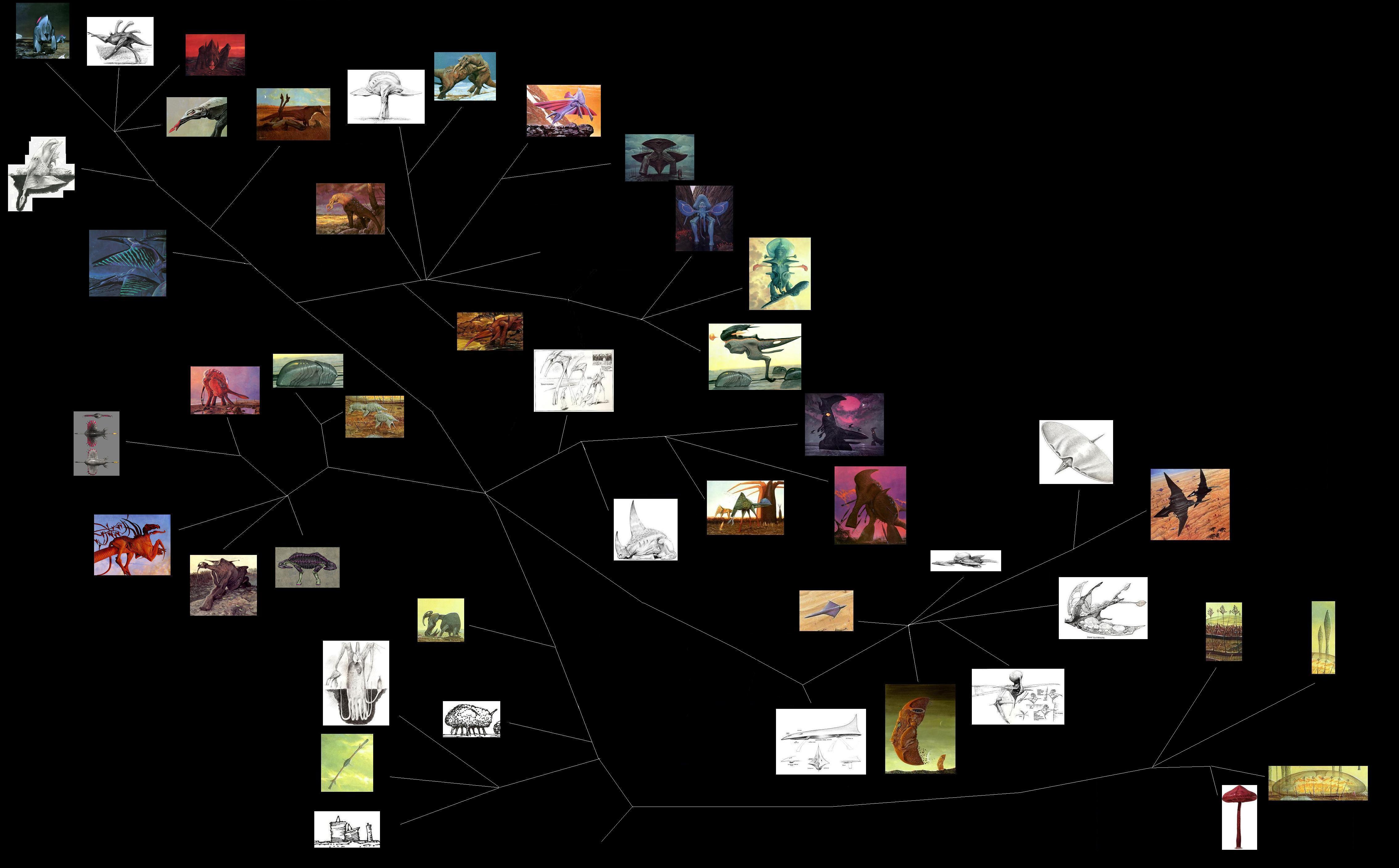
At first, I thought of making a cladogram of the creatures portrayed, but after facing this possibility, I had to toss idea away - however sometime ago a fellow deviant, Dragonthunders, tried to piece Darwinian biosphere together in a forum thread, and here is the result:


As I said before, it wouldn't be so hard at first, you can clearly relate creatures in groups, but you have to make massive stretches to relate groups between themselves, Darwinian biosphere is paradoxically diverse and at the same time so poor we can't properly relate the aliens with 100% accuracy.


CONCLUSION?

Darwin IV is a poor rendition of Triassic Earth. - M.O. Valent

Discovery's Alien Planet showed itself to be a more artistic work than a work SCIENTIFICALLY VERIFIED BY LEADING EXPERTS as it is advertised - and so far I'm very upset, and my expectations are comically low for the matter, as there will be tons of other material I will have to read with J. Jonah Jameson's spirit...

That's me having to read Expedition now...


- M.O. Valent, 18/07/2020

HIGHLIGHTS

SCIENCE&ARTWORK | BINARY STAR SUNDIAL | PART 1

IS IT POSSIBLE TO CONSTRUCT A BINARY STAR's SUNDIAL? WHY? So this last week I've been trying to work on my own sundial to settle up ...